


Your Brain Is Listening: Why Menopause Is the Most Important Window for Dementia Prevention
"I keep forgetting words. I'll be mid-sentence and the word just disappears." She paused. "And honestly, I'm more scared about that than anything else happening to my body right now."
I hear this more than almost anything else in my practice. And yet, when most women think about menopause, the conversation starts and stops at hot flashes and sleep disruption. What is rarely discussed is what estrogen is doing in your brain, and what its decline means for your cognitive health over the long term. I recently sat down with Dr. Ashanty Gajrajaweera, a neurologist with 25 years of experience and a Menopause Society Certified Physician who founded Healthspan Neurology in New York, where she focuses entirely on cognitive longevity and dementia prevention in women. This is exactly the intersection where the conversation needs to happen, and almost no one in mainstream medicine is having it.
Every woman in midlife deserves to hear what we discussed.
This Really Is a Women’s Health Issue
Here is a statistic that stopped me in my tracks: women make up roughly two-thirds of all dementia cases, and two-thirds of the caregivers as well. When Dr. G said that, I felt it land. Because when you have spent enough years in clinical practice, you stop seeing abstractions and start seeing faces. The mothers. The daughters. The wives sitting in the chair across from me. This is, in a very real and measurable sense, a disease of women.
And yet neurology and women’s health rarely occupy the same room. As an OB/GYN, my clinical world has not intersected much with neurology since residency (an eclampsia patient, the occasional complex migraine). That gap is precisely why this conversation needs to happen, and why it is long overdue.
There is one more data point worth sitting with, partly because it made us both laugh and partly because it clarifies something important. The only dementia risk factor identified as more likely to harm men than women is this: not being married. As Dr. G framed it, without a woman in their life carrying the cognitive and caregiving load, men fare significantly worse. We are going to let that sit right there. And take it as a clear reminder that no one is coming to save us. We have to take care of ourselves, on purpose, with intention.
Nearly half of dementia cases may be preventable
The Lancet Commission reviews the most rigorous available research every few years. Their 2024 report identified 14 modifiable risk factors that, if addressed, could statistically prevent approximately 45% of dementia cases. When my colleague Dr. G first read that number, she told me it was the moment she decided to spend the rest of her career in this space. I understand why.
Five of those factors are more environmental and harder to influence directly: early education, air pollution, social isolation, hearing loss, and vision loss.
The other nine are things you can actively work on with the right clinical support: high blood pressure, diabetes, obesity, physical inactivity, smoking, traumatic brain injury, LDL cholesterol, depression, and alcohol use.
That list alone should shift something for you. You have more agency over your brain health than most medicine has ever bothered to tell you.
But here is what I want you to sit with: that list is not complete, not for a woman. Sleep quality, chronic inflammation, caregiver burden, and the role of hormone therapy are absent from it. For midlife women, those are not small omissions. When you look at the full picture of modifiable risk, those factors carry more weight in women than in men. The Lancet list is a floor. It is not a ceiling.
Timing Is Everything
The brain changes associated with dementia begin 20 to 30 years before a single symptom appears.
Do the math with me. If the average age of diagnosis is around 80, and symptoms typically emerge between 70 and 75, then the underlying biological changes began somewhere between 45 and 55. That is exactly the window of the perimenopausal and menopausal transition. Not a coincidence.
Imaging research confirms what that window looks like. The PET scan work coming out of Lisa Mosconi's lab at Cornell shows decreased gray matter volume, reduced energy metabolism, increased amyloid deposition, and increased white matter hyperintensities in women during this transition, compared to age-matched men. These are not abstract findings. They are real, measurable shifts in brain structure and function, and they map directly onto the symptoms women bring into my office every week.
Women with more frequent vasomotor symptoms tend to show more white matter hyperintensities on imaging. Significant hot flash burden is also linked to higher cardiovascular risk, and the metabolic shifts that often accompany this transition (rising LDL, increasing insulin resistance) affect cerebral blood flow as well. So when I am sitting across from a woman with significant vasomotor symptoms and white matter changes on imaging, and she is weighing whether to start hormone therapy, that imaging is part of the clinical picture. I am not on the fence for her.
Ready to go deeper?
Three Ways to Connect With Dr. Moyers
| Apply for Membership (Fort Worth, TX patients) — Concierge-level women's health care tailored to your body, your symptoms, and your life. |
| Weekly Newsletter — Evidence-based insights on hormones, vitality, and midlife health. Free, wherever you are. |
| Sky Women's Health Podcast — Real conversations about the health topics mainstream medicine skips. |
| Apply for Membership | Join the Newsletter | Listen to Podcast |
Your Brain Is More Resilient Than You Think
One of the most clarifying things I heard at this conference: your brain is downstream of nearly everything your body is doing. It is so resilient that it compensates for years, even decades, until it simply cannot anymore. When I heard that, I thought: that is the story of so many women I see. We keep going until we cannot. Our brains do exactly the same thing.
That resilience is not fixed. Neuroplasticity continues throughout your entire life, and we now know neurogenesis (the creation of new neurons) continues even into your 90s. Think of your brain as a high-achieving student: give it the right stimulus and the right environment, and it is primed to grow.
Researchers can now measure markers like phosphorylated tau (p-tau 217) directly in blood. Among people over 70 with elevated levels, only about one third have cognitive symptoms. Another third have mild symptoms, and a full third are functioning completely normally. The reason is cognitive resilience: robust synaptic activity, healthy mitochondrial energy production, and an intact blood-brain barrier that keeps the brain working even as age-related changes accumulate. The goal is not just a longer life. It is a longer healthspan, where your brain stays present for all of it.
What a real prevention plan looks like
“Eat well, exercise, sleep more” isn’t wrong, but it isn’t a strategy either. A real prevention plan is specific, and it looks like this:
- Assess your individual risk using family history, genetics, imaging, cognitive testing, and relevant biomarkers.
- Modify what you can by targeting your specific risk factors, not a generic checklist that treats every woman the same.
- Optimize intentionally with exercise aimed not just at weight or strength, but at building and protecting brain tissue, with measurable follow-up over time.
The research on physical activity and dementia risk is genuinely compelling. We are not talking about elite athletes here. We are talking about women who garden, who walk, who simply stay in motion through their days. That kind of consistent movement may reduce dementia risk in meaningful, measurable ways. That is powerful, and it is something you can act on right now.
Where Hormone Therapy Fits
This is genuinely nuanced, and I want to be precise about it. There is no approved indication for hormone therapy to prevent dementia, and the decision is deeply individual: shaped by your risk factors, your personal and family history, your symptoms, and whether you are still within the window of opportunity. Observational studies do suggest lower dementia risk in women who used estrogen in perimenopause or early menopause, but observational data has real limits, and initiating hormone therapy much later in life does not appear to carry the same potential benefit.
The science around estrogen and brain health is moving faster than most clinicians are tracking. That is exactly why I stay actively engaged with the research as it develops, so that the guidance I give you reflects what the evidence actually says, not what was taught in training a decade ago.
If you are in your 60s or 70s and feel like you missed your window, I want you to hear this clearly: you have not missed the boat. Hormone therapy is one tool in a much larger framework, and there is a great deal you can do right now to support your brain. That conversation is worth having, wherever you are in the process.
What I wish every woman knew
The symptoms you bring to your gynecologist today need to be addressed today, and they need to be understood as signals that matter for the next 20 to 30 years of your life. "Let's wait and see in a year" is not a plan. It is a missed opportunity, and your brain health cannot afford it.
This is the season when everyone else is pulling at you. Your caregiving load is real, your sleep deprivation is real, and the chronic stress that comes with both is not just exhausting: it is physiologically harmful. Inflammation is increasingly understood as a driver of neurodegeneration. The window to act is now, not after symptoms of cognitive decline appear, not even after menopause is behind you. Now, during this perimenopause transition, while the evidence supports intervening and while your body is still responding.
You do not have to white-knuckle your way through this transition hoping nothing goes wrong on the other side. Proactive, personalized care is not a luxury. It is what you deserve from your healthcare. If you are ready for a partner in building a midlife brain-health strategy that actually takes you seriously, I invite you to apply for membership at Sky Women's Health.
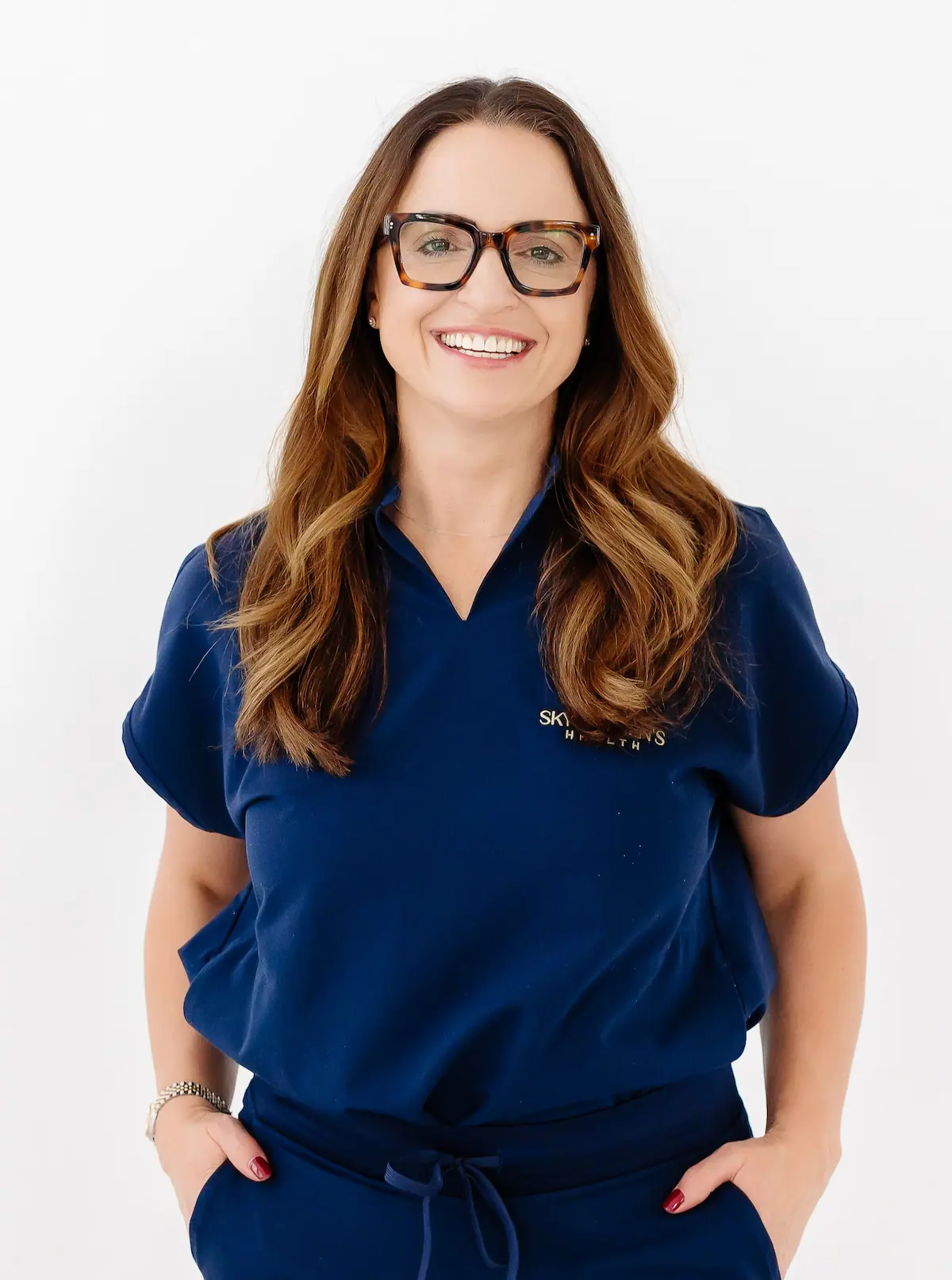
Dr. Carolyn Moyers, Board-Certified OB/GYN | Menopause Society Certified | ISSWSH Fellow
This article is for educational purposes only and is not a substitute for professional medical advice, diagnosis, or treatment. Decisions about hormone therapy and dementia risk should be made with your own physician.
Your next step
You Deserve Care That Actually Listens
Whether you're in Fort Worth and ready for personalized care, or anywhere in the world and looking to stay informed — there's a place for you here.
Membership — Concierge women's health care for Fort Worth, TX patients
Newsletter — Free weekly insights on hormones and vitality, available everywhere
Podcast — Real conversations mainstream medicine skips
| Apply for Membership | Join the Newsletter | Listen to Podcast |